





If you've ever wondered whether now is the moment to take your Amazon brand international, here's the truth: 2026 presents a major opportunity for brands that are ready to expand beyond their home marketplace. Cross-border ecommerce continues to create new opportunities, while Amazon's expanding marketplace and fulfillment ecosystem makes it easier for established sellers to reach customers in different regions.
But international expansion is not simply about opening another marketplace, translating a listing, and sending inventory overseas. Every country has its own customer behavior, search patterns, competitors, pricing expectations, logistics requirements, tax considerations, and regulatory environment. A strategy that works in the US may not deliver the same results in Germany, France, the UK, UAE, Japan, or another international marketplace.
The brands that succeed internationally are the ones that treat expansion as a business strategy rather than a marketplace setup task. They identify the right markets, understand demand and competition, calculate profitability, localize their listings, plan inventory, manage compliance, and build marketplace-specific advertising strategies before committing significant capital.
This is where a structured international expansion strategy becomes valuable. Instead of guessing which country to enter next, brands can compare opportunities, model potential returns, understand operational requirements, and create a phased roadmap for sustainable growth.
The Global Amazon Landscape in 2026
The global Amazon ecosystem is becoming increasingly important for brands that have already established themselves in their primary marketplace. The US remains one of Amazon's largest and most competitive markets, but international opportunities are expanding across Europe, MENA, and APAC.
For established sellers, this creates an important strategic question: should the next dollar of investment go toward gaining more market share in an already competitive marketplace, or should the brand use its existing product, customer insights, and operational knowledge to enter a new country?
There is no universal answer. The decision depends on the product, category, margins, competition, supply chain, and customer demand. International expansion can be highly attractive, but only when the target marketplace provides a realistic path to profitable growth.
The Rise of Non-US Marketplaces
The US used to dominate Amazon's ecosystem for many international sellers. That is no longer the only growth story. European marketplaces such as Germany, France, Spain, Italy, and the Netherlands are attracting brands that want access to established ecommerce audiences and opportunities beyond the highly competitive US marketplace.
Meanwhile, markets such as the UAE, Saudi Arabia, Singapore, Japan, and Australia can provide opportunities for brands with products that match local customer demand. The size and maturity of each marketplace vary, which means sellers need to evaluate each country independently rather than assuming that one international strategy will work everywhere.
The important factor is not simply how large the marketplace is. A smaller market with lower competition, stronger pricing power, and better product-market fit can potentially generate a stronger return than a much larger marketplace where established competitors dominate the category.
Amazon's Investment in International Logistics
Logistics has historically been one of the biggest challenges for brands entering international markets. Moving inventory across borders introduces additional freight costs, customs requirements, delivery considerations, storage costs, and inventory planning challenges.
Amazon's expanding fulfillment ecosystem provides sellers with more options for international operations. Depending on the marketplace and product, brands can evaluate FBA Export, regional fulfillment programs, local FBA, third-party logistics providers, and hybrid models.
However, more fulfillment options do not eliminate the need for careful planning. Sellers still need to calculate the complete cost of getting products from the manufacturer to the final customer. That includes freight, customs where applicable, Amazon fees, storage, returns, taxes, and the working capital required to maintain sufficient inventory.
Competition Is Becoming Regional
Sellers are no longer fighting on one global battlefield. A product may face intense competition in the US but encounter a much less saturated environment in Germany, France, Saudi Arabia, or another marketplace.
This creates potential opportunities for brands that identify market gaps early. If leading competitors in a target marketplace have weak listings, limited product differentiation, poor reviews, or high prices, a well-positioned brand may be able to capture customers without facing the same barriers that exist in a mature marketplace.
However, lower competition does not automatically mean lower risk. Demand still needs to be strong enough, pricing needs to support healthy margins, and the brand needs to be able to operate within local regulatory and fulfillment requirements.
What this really means is simple: international expansion should be based on where your product can win profitably, not simply where Amazon has a marketplace.
Why Brands Partner With Sellers Umbrella for Global Expansion
Sellers Umbrella approaches international expansion using market intelligence, profitability analysis, and a structured expansion strategy rather than relying on assumptions. Its current international expansion offering includes market selection, international tax and compliance guidance, listing localization, international fulfillment management, and cross-border logistics coordination.
This approach is important because every part of an international launch is connected. Market selection affects pricing. Pricing affects profitability. Profitability affects advertising budgets. Advertising affects inventory requirements. Inventory affects fulfillment. Compliance can affect the entire launch timeline.
Here's how the process works.
Category Demand Analysis
The first step is understanding where your category has genuine demand.
Search volume provides a useful starting point, but it is not enough to determine whether a marketplace is attractive. We analyze search demand, category trends, product-level demand, seasonality, average selling prices, competitive density, and the strength of existing brands.
The objective is to identify marketplaces where customers are actively looking for products like yours and where the category provides sufficient room for a new or expanding brand to compete.
A market with 100,000 highly relevant searches can potentially be more attractive than a market with one million searches if competition is substantially lower and customers are willing to pay a price that supports healthy margins.
Competitor Viability Studies
International competitor research goes beyond identifying the top products.
We analyze saturation, pricing patterns, review counts, ratings, listing quality, product variations, A+ Content, promotional activity, advertising presence, and customer feedback. This helps determine what customers already expect from leading products and where competitors may be leaving opportunities open.
Reviews are particularly valuable because they provide direct insight into customer dissatisfaction. If shoppers repeatedly complain about packaging, product durability, missing accessories, unclear instructions, poor customer support, or another issue, those weaknesses can potentially become part of the new brand's differentiation strategy.
The goal is not to copy competitors. The goal is to understand the competitive environment well enough to identify where your brand can create a stronger customer proposition.
Price Positioning Models
International pricing is not a copy-paste exercise.
A product selling for $39.99 in the US cannot simply be converted into euros, pounds, dirhams, or yen. Local competitors, purchasing power, marketplace fees, fulfillment costs, taxes, freight, advertising, returns, and currency fluctuations all influence the appropriate selling price.
The analysis therefore needs to determine both the market's willingness to pay and the minimum price required to maintain the desired contribution margin.
A strong international pricing model can also identify opportunities for premium positioning, introductory pricing, promotional offers, and future price increases once the product establishes stronger demand.
Regulatory Checklists
Every marketplace has its own regulatory considerations.
Depending on the product and country, sellers may need to address product safety, certifications, labeling, packaging, environmental obligations, tax registration, import documentation, and category-specific requirements.
These requirements should be identified before inventory is manufactured or shipped. Discovering a compliance issue after products have already reached the destination market can result in delays, additional expenses, or restrictions on selling.
AI-Driven Forecasting Powered by Manus
AI can make international market analysis considerably faster by allowing brands to evaluate multiple scenarios at the same time.
Sellers Umbrella uses Manus alongside other AI tools to support multi-marketplace demand simulations, profitability analysis, keyword clustering, competitive research, pricing scenarios, and ROI projections.
The value of AI is not that it eliminates strategic decision-making. Instead, it allows teams to process more information and evaluate more scenarios before making an investment decision.
A strong model can consider factors such as VAT, import duties, currency fluctuations, FBA fees, advertising costs, product margins, and expected demand to create a more realistic picture of potential profitability.
Brands trust this data-backed foundation because it keeps international expansion strategic instead of experimental.
Choosing the Right Amazon Marketplace
A successful Amazon global selling launch starts with selecting the right marketplace, not necessarily the biggest one.
The right market should provide enough customer demand, a realistic competitive environment, acceptable pricing power, manageable logistics, and a compliance path that makes commercial sense.
Market Size
Market size determines the potential size of the customer opportunity, but it should never be considered in isolation.
A large marketplace can provide enormous revenue potential while also requiring significant advertising investment and a long period to establish organic visibility. A smaller marketplace may provide a more manageable entry point if the category is growing and competitors are less established.
The important question is not simply, "How many customers are there?" It is, "How many relevant customers are likely to purchase this product, and how difficult will it be to reach them?"
Demand vs Competition
Demand and competition need to be analyzed together.
If search demand is strong but the first page is dominated by brands with thousands of reviews, aggressive PPC budgets, and established customer loyalty, entering that market may require substantial investment.
Conversely, a marketplace with moderate demand but fewer dominant competitors can create an opportunity for a differentiated product to gain visibility more quickly.
Pricing Power
Pricing power determines whether customers in the target market will support your desired price.
Premium products need markets where customers recognize the value of quality, design, performance, safety, convenience, or brand reputation. If customers are highly price-sensitive, premium positioning may require significantly more education and differentiation.
FBA Logistics and Cost Structure
Fulfillment fees, storage costs, shipping timelines, returns, and inventory requirements can significantly change marketplace economics.
A product that generates excellent margins in one marketplace may have considerably lower margins elsewhere because of differences in fulfillment and logistics.
Before selecting a marketplace, sellers should model the complete landed cost and determine the contribution margin after all major expenses.
Compliance Friction
Some products can enter a marketplace relatively easily, while others require certifications, testing, labeling, packaging changes, registrations, or additional documentation.
Compliance should therefore be part of the market-selection process.
This evaluation determines where you can gain traction fastest and where your investment has the strongest potential return.
Case Study: Multi-Marketplace Launch Strategy
A baby skincare brand approached Sellers Umbrella with plans to expand internationally. They were unsure whether to launch in the US first or start with Europe.
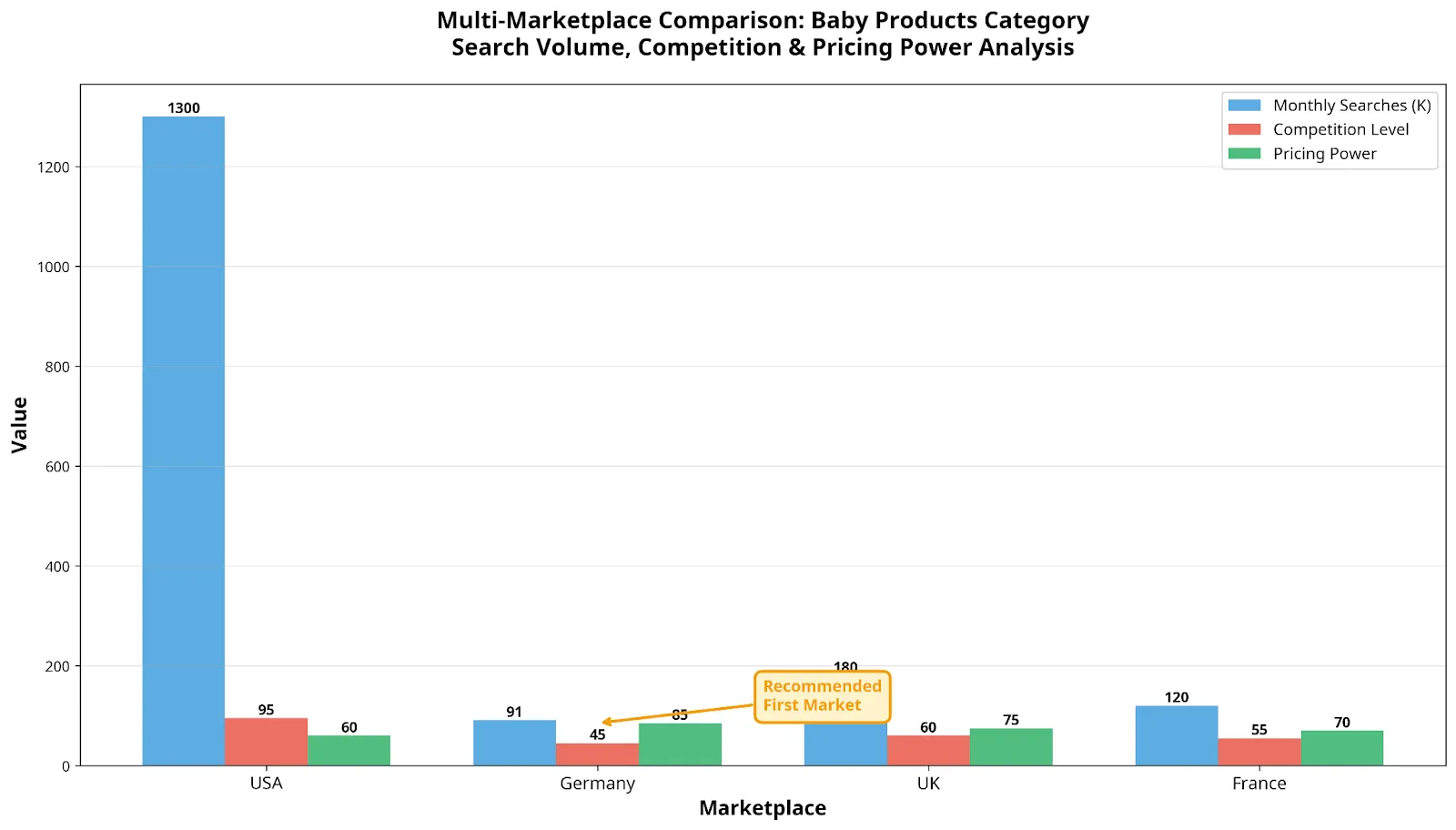
Rather than making the decision based only on marketplace size, Sellers Umbrella conducted a full Amazon Global Selling Strategy analysis across four marketplaces: the USA, Germany, the UK, and France.
The analysis considered search demand, competition, pricing potential, customer expectations, and overall profitability.
1. Market Size Comparison
The analysis showed approximately 1.3 million monthly searches in the USA compared with approximately 91,000 monthly searches in Germany.
At first glance, the US appeared to be the obvious opportunity because of its significantly larger search volume.
However, search volume was only one part of the analysis. Once competition, saturation, pricing power, and customer expectations were considered, Germany showed stronger profitability potential.
2. Why We Recommended Germany First
Germany outperformed in four key areas.
First, shoppers in the category placed significant emphasis on quality, certifications, and safety. Second, there was stronger potential for premium positioning. Third, competition was less saturated than in the US. Finally, the product could maintain stronger pricing power despite the lower overall search volume.
This made Germany the ideal test market before scaling into larger and more competitive marketplaces.
The case demonstrates an important international expansion principle: high search volume does not always mean the best starting market.
3. Phased Expansion Plan
The expansion was planned over 24 months rather than launching every marketplace simultaneously.
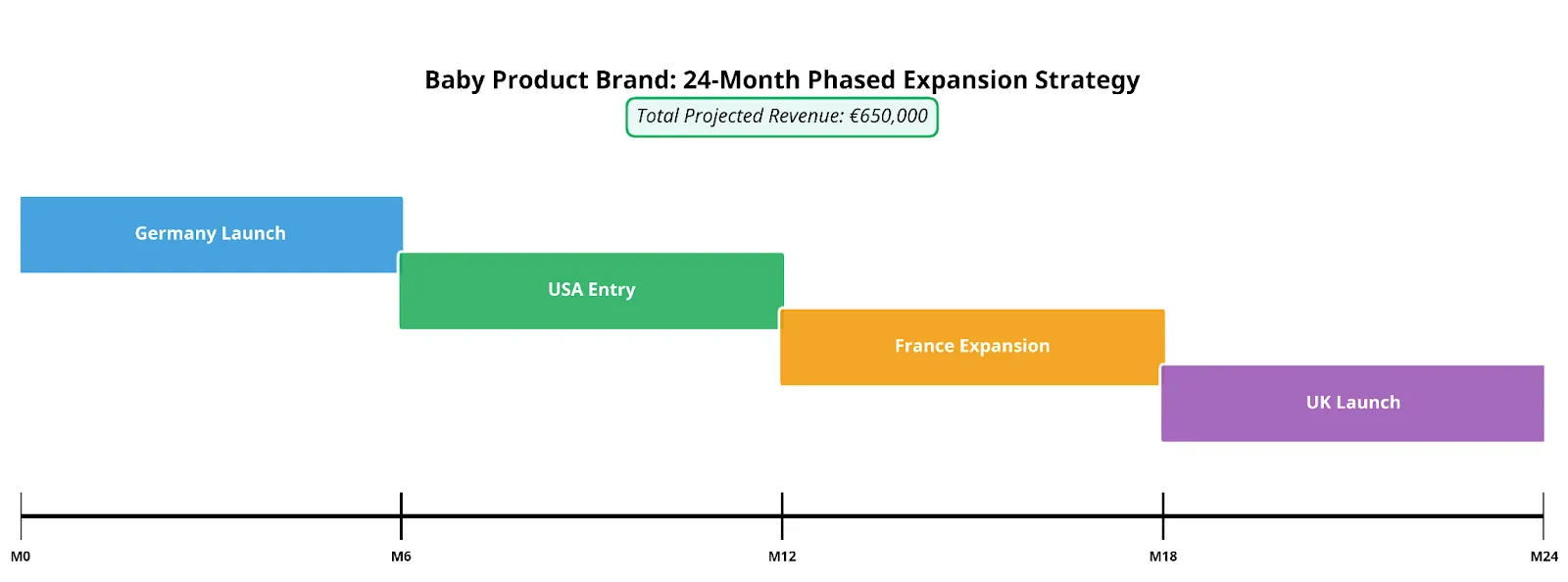
During months 1 to 6, the focus was Germany. The brand could establish its listing, validate demand, test PPC campaigns, optimize conversion, understand customer behavior, and build reliable inventory processes.
During months 7 to 12, the strategy moved into the USA, using the lessons from Germany to improve positioning, advertising, inventory planning, and operational execution.
During months 13 to 18, the brand expanded into France, followed by the UK during months 19 to 24.
This structured rollout allowed the brand to manage budgets, optimize logistics, learn from each marketplace, and increase profitability with every stage.
4. Revenue Projections
Across all four marketplaces, the 24-month projection came to €650,000.
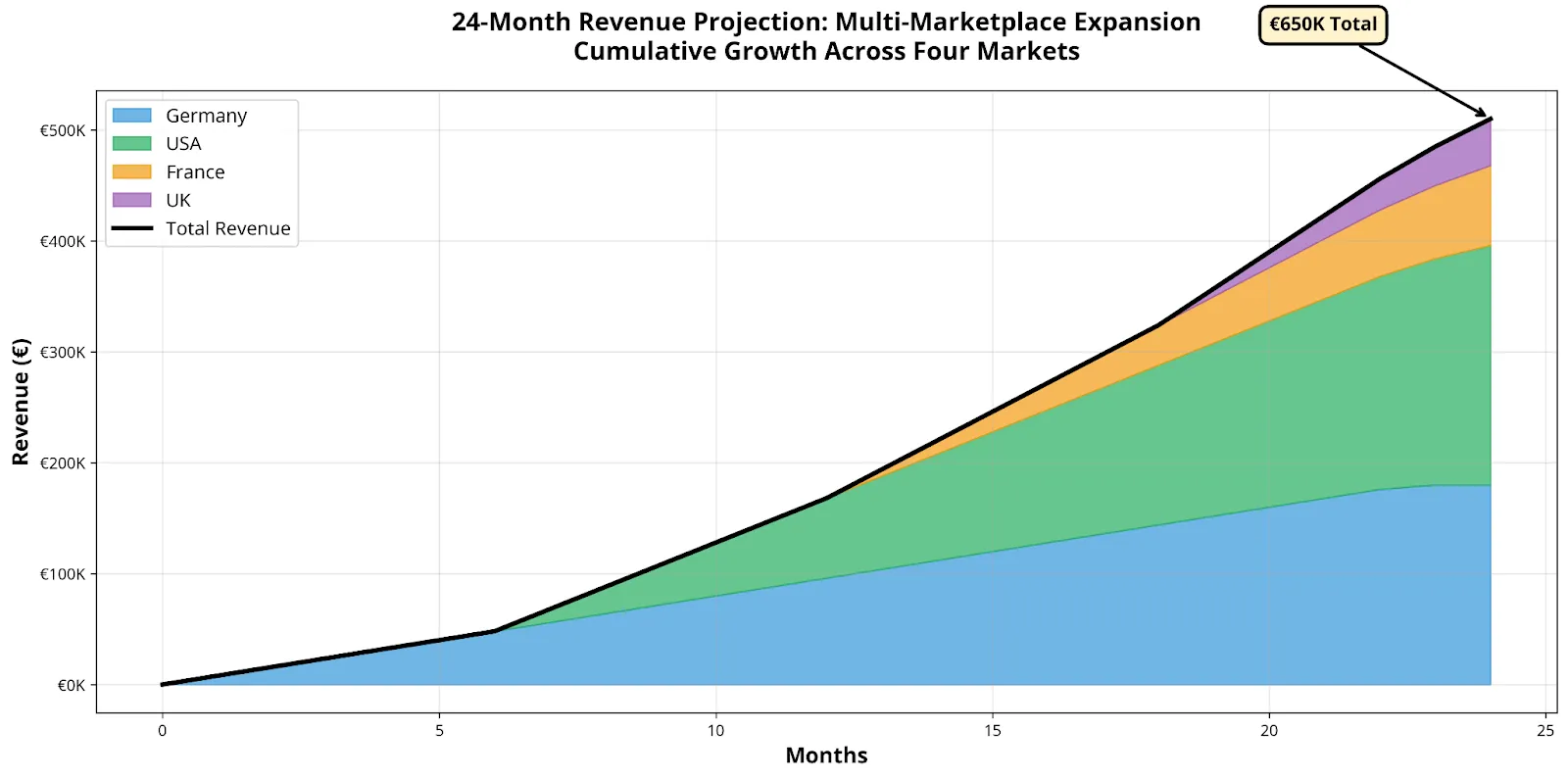
Revenue projections should always be treated as planning scenarios rather than guarantees. Actual results depend on sales velocity, conversion rate, average selling price, advertising investment, competition, inventory availability, seasonality, returns, and operating costs.
The purpose of forecasting is to understand the range of possible outcomes and determine how much capital should be allocated to each market.
5. Key Insight
High search volume does not always mean the best starting market.
Competition, pricing strength, category saturation, certification requirements, fulfillment costs, and advertising economics can have a much greater impact on profitability than total search volume.
This is why international expansion should begin with a data-backed market assessment rather than an assumption about which country is largest.
Want a data-backed multi-marketplace roadmap like this? Sellers Umbrella's Strategic Consulting & Growth Services includes international marketplace prioritization, launch sequencing, market opportunity assessment, regulatory planning, localization strategy, logistics planning, and phased expansion roadmaps.
Logistics & Fulfillment: Building Global Delivery Efficiency
Logistics can make or break international expansion. A product may have strong demand and excellent conversion but still produce weak margins if shipping, fulfillment, storage, and returns are not planned correctly.
The fulfillment model should therefore be selected based on product dimensions, weight, sales velocity, delivery expectations, marketplace economics, and inventory requirements.
FBA Global Export
For eligible products and marketplaces, cross-border fulfillment can provide a way to test international demand without immediately committing significant inventory to local fulfillment centers.
This can reduce early-stage inventory risk and simplify the initial launch.
However, sellers should compare delivery times and total costs against local fulfillment before scaling.
Hybrid Models: 3PL + Amazon
Some markets benefit from combining third-party logistics providers with Amazon FBA.
A 3PL can store reserve inventory, consolidate shipments, prepare products, and replenish Amazon fulfillment centers based on actual demand.
This approach can be particularly useful for brands with long manufacturing lead times or multiple international marketplaces.
Sellers Umbrella's account and marketplace management capabilities include strategic inventory forecasting, replenishment recommendations, FBA inbound shipment management, FBA Export guidance, storage fee optimization, and international fulfillment support.
Country-Specific Realities
Delivery expectations differ from country to country.
Customers in Germany may place strong emphasis on reliable and fast delivery, while customers in the UAE may prioritize delivery reliability and tracking transparency. Japanese consumers may have particularly high expectations around packaging, presentation, product quality, and attention to detail.
The fulfillment strategy should therefore consider not just the shipping cost but the customer experience created by the delivery process.
Localization: Beyond Translation
Global markets do not respond to copy-pasted listings. They respond to listings built around local culture, search behavior, competitive positioning, and customer expectations.
Translation changes the language. Localization changes the commercial strategy.
Keyword Localization
Keyword research should be conducted separately for every marketplace.
For example, a US customer may search for "baby lotion," while German shoppers may use different local terms depending on the exact product. Simply translating the US keyword can miss the search behavior that actually drives local demand.
The process should therefore involve local keyword research, competitor analysis, search-intent mapping, and marketplace-specific content creation.
Cultural Adaptation
Customer expectations can differ significantly between markets.
Images, messaging, examples, measurements, claims, product benefits, and lifestyle positioning may all require adaptation.
The objective is to maintain consistent global brand identity while ensuring that the local customer sees a product that feels relevant to them.
SEO Rewrites
Amazon SEO should be adapted to each marketplace.
Titles, bullet points, descriptions, backend search terms, A+ Content, Brand Story, and image messaging should be optimized around local search behavior.
Sellers Umbrella provides Product Content & Listing Optimization, including listing copy, keyword optimization, competitor analysis, backend search terms, and A+ Content.
Pricing Recalibration
Pricing should be recalibrated according to local purchasing power, competitor pricing, marketplace fees, fulfillment costs, taxes, and target contribution margin.
A global brand may therefore have different prices in different countries while maintaining consistent overall positioning.
Competitor Benchmarking
Competitor listings provide valuable information about what customers already expect.
Research should compare titles, images, reviews, ratings, pricing, variations, promotions, A+ Content, and product claims.
This helps identify gaps that can be used to improve positioning.
Compliance Checks
Localization also applies to packaging, labels, claims, warnings, and product information.
A listing may be commercially strong and still create problems if the product itself does not meet the destination market's requirements.
This is why localization and compliance need to be considered together.
This isn't translation. It's full-funnel localization designed to convert.
Compliance, Taxes & Certifications
Compliance is one of the biggest reasons sellers delay international expansion. With the right process, it becomes more manageable.
Every market can have different requirements relating to taxes, product safety, packaging, labeling, certifications, and import documentation.
VAT and Tax Requirements
European expansion can introduce additional VAT obligations depending on where inventory is stored and how the business operates.
Brands should understand their tax position before distributing inventory across multiple countries.
Packaging and Label Regulations
Packaging requirements may include local language, safety information, recycling information, product details, warnings, and other market-specific requirements.
These requirements should be reviewed before inventory production rather than after the products arrive.
Product Safety Standards
Certain product categories require additional safety documentation or testing.
Brands should identify these requirements before launch so that certification and testing costs can be included in the expansion budget.
Regional Certifications
Some products require market-specific certifications or approvals.
The exact requirements depend on the product and destination country, so the compliance assessment needs to be product-specific rather than based on a generic international checklist.
Amazon Brand Registry
International expansion also increases the importance of brand protection.
Amazon Brand Registry can help eligible brand owners establish greater control over their product detail pages and protect intellectual property across marketplaces.
Sellers Umbrella's international marketplace management includes guidance around international tax and compliance requirements, listing localization, international fulfillment, and Amazon Brand Registry support.
This end-to-end approach keeps the launch more organized and reduces the risk of discovering critical requirements after inventory has already been committed.
How AI Is Transforming Global Expansion
AI is no longer simply a content-generation tool. It can now support market research, forecasting, keyword analysis, competitor research, pricing models, and advertising analysis.
At Sellers Umbrella, Manus is used alongside other AI tools to support international expansion decisions.
AI Forecasting
AI can compare multiple marketplace scenarios and identify where the brand may reach its target return most efficiently.
Instead of looking at one forecast, teams can model conservative, expected, and aggressive demand scenarios.
Geographical Keyword Clustering
AI can help organize keywords by country, search intent, product type, and customer need.
This makes it easier to identify differences between marketplaces and build localized keyword strategies.
Automated Compliance Flagging
AI can assist with identifying product claims, listing content, and marketplace requirements that may require additional review.
However, final legal and regulatory decisions should always be validated against the applicable requirements and qualified professionals where necessary.
Demand Simulation
New product launches can be simulated under different demand, pricing, and advertising assumptions.
This can help determine inventory requirements before the brand commits significant capital.
Pricing Engines
AI-assisted pricing models can account for currency changes, competitor pricing, fees, and margin targets.
This can help brands respond to market changes more systematically.
International Advertising Insights
AI can also analyze advertising performance across markets and identify patterns in keywords, conversion, wasted spend, and budget allocation.
The result is a faster feedback loop between marketplace data and strategic decision-making.
Our Proven 6-Phase Expansion Framework
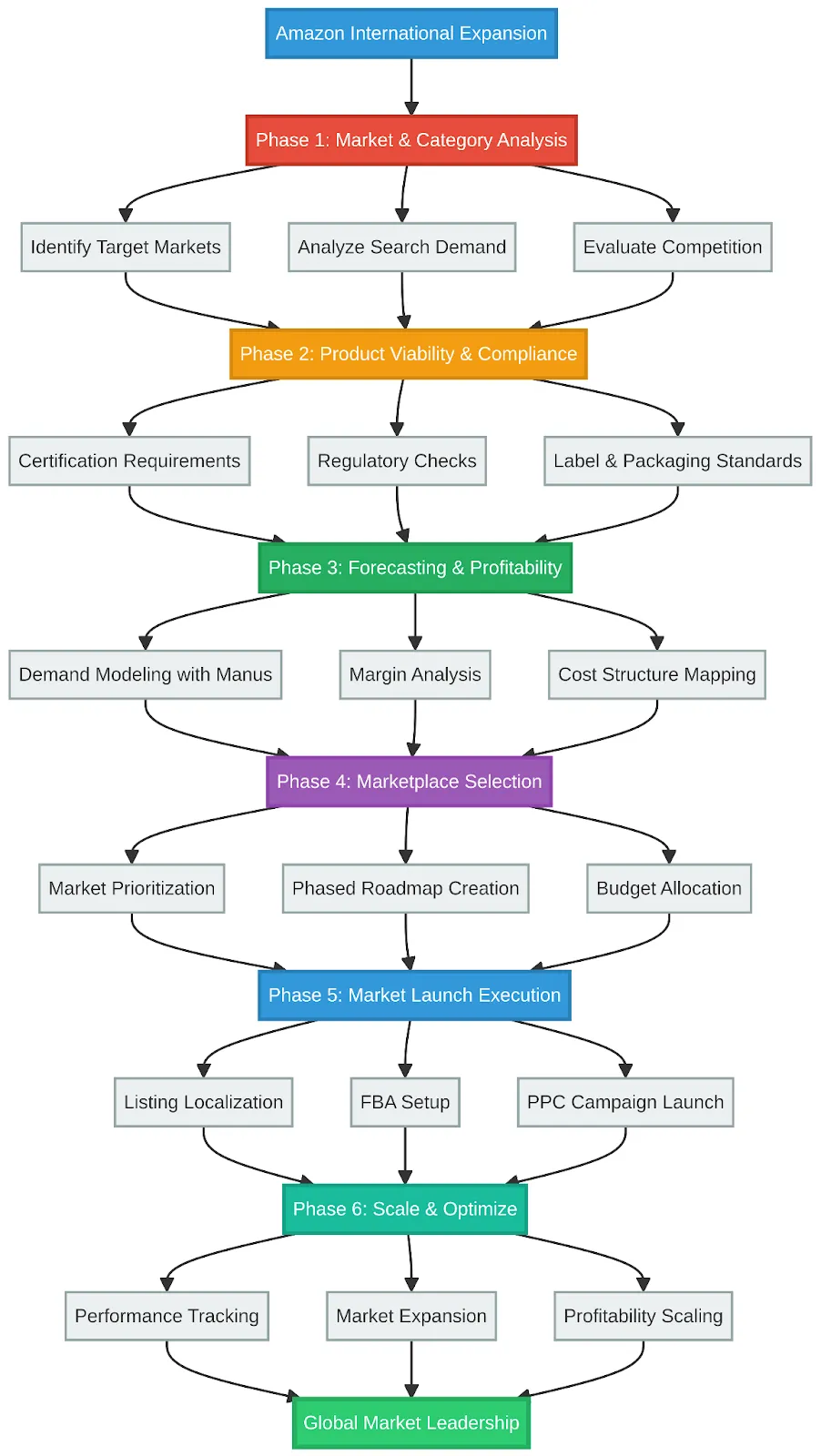
Sellers Umbrella follows a structured framework designed to keep every expansion on track.
1. Market & Category Analysis
The first step is identifying where the product has the strongest potential.
Demand, competition, pricing, category maturity, search behavior, and customer expectations are analyzed across potential marketplaces.
2. Product Viability & Compliance Checks
The second step confirms whether the product is suitable for the target market.
This includes reviewing certifications, product safety, packaging, labeling, taxes, documentation, and other regulatory considerations.
3. Forecasting & Profitability Evaluation
The third step models demand, revenue, fees, advertising costs, fulfillment expenses, and product margins.
The objective is to understand the potential contribution margin rather than focusing only on revenue.
4. Marketplace Selection & Roadmapping
The fourth step selects the most attractive marketplace and establishes the order in which additional countries should be launched.
This prevents brands from spreading their resources too thin across multiple markets.
5. Market Launch Execution
The fifth step turns the strategy into an operational launch.
Listings are localized, logistics are established, inventory is prepared, advertising campaigns are launched, and performance is monitored.
Sellers Umbrella's Amazon Product Launch Services cover market and keyword research, listing optimization, pricing and profitability analysis, inventory planning, PPC launch campaigns, and post-launch optimization.
6. Scale, Optimize, Expand
The final stage focuses on performance improvement and controlled expansion.
Once the first marketplace demonstrates consistent demand and acceptable economics, the brand can decide whether to scale the existing market, introduce additional products, or enter the next country.
This repeatable system allows brands to grow internationally while controlling risk at every step.
Common Amazon International Expansion Mistakes
International expansion can become expensive when brands move too quickly without understanding the commercial and operational implications.
Expanding Into Too Many Markets at Once
Launching several countries simultaneously can create unnecessary complexity across inventory, compliance, PPC, customer service, and reporting.
A phased approach allows brands to validate one market before committing resources to the next.
Choosing a Market Based Only on Search Volume
Search volume is important, but it does not guarantee profitability.
A market with high demand can still be unattractive if CPCs are high, competitors are dominant, margins are weak, or compliance costs are significant.
Copying US Listings
Directly translating a US listing rarely produces the strongest international result.
Local keyword research, competitor analysis, cultural adaptation, and marketplace-specific messaging are necessary.
Ignoring Compliance Until After Launch
Compliance should be evaluated before inventory is shipped.
Waiting until the product reaches the destination market can result in delays, additional costs, or restrictions.
Underestimating Working Capital
International expansion requires cash for inventory, freight, compliance, advertising, taxes, packaging, and potentially returns.
Brands should understand their cash requirements before committing to a marketplace.
Launching Without Enough PPC Budget
New listings need traffic and conversion data.
Advertising should therefore be part of the launch plan rather than treated as an optional activity after launch.
Sending Too Much Inventory
Overestimating demand can tie up working capital and increase storage costs.
Inventory should be based on realistic sales forecasts and replenishment timelines.
Treating Every Marketplace the Same
Each marketplace needs its own strategy.
Global branding can remain consistent, but keywords, pricing, PPC, content, inventory, and customer experience should be adapted to local conditions.
How Much Does Amazon International Expansion Cost?
There is no universal cost for Amazon international expansion.
The total investment depends on product category, target country, compliance requirements, inventory model, fulfillment strategy, localization requirements, advertising budget, and operational support.
Costs can include inventory, international freight, customs-related expenses, FBA fees, storage, product certifications, packaging changes, listing localization, creative assets, PPC, taxes, and returns.
The most useful financial question is not simply, "How much will the launch cost?"
It is:
"How much capital will we need before this marketplace reaches sustainable profitability?"
A strong financial model should therefore calculate the initial investment, ongoing operating expenses, expected sales, contribution margin, and working-capital requirements.
When Should an Amazon Brand Expand Internationally?
International expansion should generally come from a position of strength.
A strong candidate typically has a proven product, reliable supply chain, healthy margins, strong customer reviews, stable inventory, and a functioning PPC strategy.
The brand should also have sufficient working capital to support the launch period.
If the core marketplace is already experiencing stockouts, poor conversion, weak margins, or uncontrolled advertising costs, entering another country can multiply the underlying problems.
The goal is to export a proven operating model into another marketplace, not export unresolved problems.
What Makes an International Expansion Successful?
Successful international expansion is built on several connected components.
The brand needs accurate market research to identify opportunity, competitor analysis to understand the landscape, financial modeling to protect margins, localization to reach customers, compliance planning to reduce risk, logistics to deliver products efficiently, and PPC to generate visibility.
No single component can compensate for a weak foundation elsewhere.
A great listing cannot solve poor inventory management. Strong demand cannot solve an unprofitable fulfillment model. Excellent PPC cannot fix a product that does not meet local customer expectations.
The strongest brands therefore approach international expansion as a complete operating system.
Wrapping It Up
2026 presents a major opportunity for Amazon brands that are ready to expand beyond their existing marketplace. International ecommerce gives established brands access to new customers, additional revenue opportunities, and markets where competitive conditions may differ significantly from their home country.
But the key isn't simply expanding.
It's expanding strategically.
The right marketplace needs to be selected based on demand, competition, pricing power, fulfillment economics, compliance requirements, and long-term growth potential. Listings need to be localized rather than simply translated. Advertising needs to be built around local search behavior. Inventory needs to be forecast before launch. And profitability needs to be measured after the complete cost of operating internationally is considered.
Sellers Umbrella provides Account & Marketplace Management, including international marketplace expansion, market analysis, tax and compliance guidance, listing localization, international fulfillment, and cross-border logistics coordination.
For brands that need to build demand beyond high-intent search, Amazon DSP Ads can extend advertising across Amazon and the wider digital ecosystem using audience-based targeting.
Brands can also use Amazon Sponsored Display to reconnect with shoppers who have viewed products, target relevant audiences, and remain visible throughout the consideration journey.
International expansion is ultimately about building a repeatable growth system.
The brands that win will not necessarily be the ones that enter the most countries first. They will be the brands that select the right markets, understand their economics, localize effectively, manage operational complexity, and scale only when the data supports the next move.
If you're considering international expansion, the first step is not opening another marketplace account.
The first step is determining which marketplace gives your product the strongest opportunity to build demand, achieve profitability, and create long-term market share.
That is where a data-backed international expansion strategy makes the difference.
